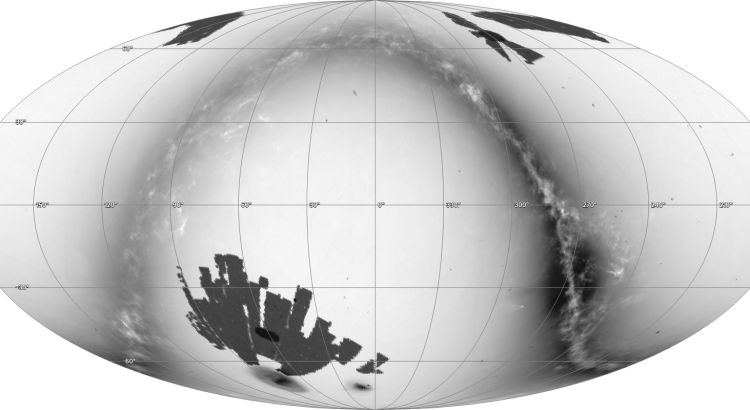
On 12 November 2026, ESA’s Euclid mission published DR1-Foundation, its first major data release. It covers about 13 months of observations and around 1,900 deg² of the Euclid Wide Survey, plus the Euclid Deep Fields. The release adds up to some 1.7 million GB of data: more than 900 million galaxies, over 60 million quasar candidates, around 15,000 strong gravitational lens candidates and spectra for more than 160 million sources. For the first time, scientists have the pieces they need to start building Euclid’s 3D map of the Universe and to study dark matter, dark energy and the cosmic web. The full DR1, expected in mid-2027, will add weak lensing and galaxy cluster data.
PIC, a centre jointly operated by IFAE and CIEMAT, has been part of Euclid since its early stages. Together with ICE-CSIC, PIC has been responsible for the mission’s cosmological simulations, which were used to optimise the survey and to prepare the software for processing and analysing the data. PIC is also Euclid’s Science Data Centre in Spain.
The DR1-Foundation catalogues are now accessible through CosmoHub, PIC’s platform for the interactive analysis of large astronomical datasets. Users can find 46 catalogues, with the same table and column names as the ESA Euclid Science Archive:
• the MER photometric and morphological catalogues;
• photometric redshifts with their full probability distributions;
• spectroscopic redshifts, classifications and line measurements;
• the combined 1-D spectra, stored as a table.
Photo-z probability distributions and spectra can be selected, cross-matched and combined directly with SQL, without downloading a single file. Researchers can thus access and analyse this magnificent dataset almost immediately and with ease, from simple queries to large statistical studies.